Ask five business owners “what are management accounts?” and you’ll likely get five different answers. One will mumble something about spreadsheets. Another will say “isn’t that just my tax return?” (it isn’t). A third will simply say, “my accountant handles that.”
At FA Accountants, we hear these answers often. And honestly, the confusion makes sense. Nobody teaches this in school. So let’s clear it up properly, without the jargon.
Management Accounts Meaning: The Simple Version
Management accounts are internal financial reports a business produces regularly, usually every month, to track how it’s actually performing. Think of them as a health check-up for your company, except instead of blood pressure, you’re checking cash, profit, and costs.
Unlike your annual accounts, which exist mainly to satisfy HMRC and Companies House, management accounts exist to help you make better decisions. Nobody outside your business is legally required to see them. That’s the whole point.
Your monthly business performance reporting toolkit, built for decision-making rather than compliance.
Extra Reading: How Much Does An Accountant Cost Per Month?
What’s Actually Inside a Management Account
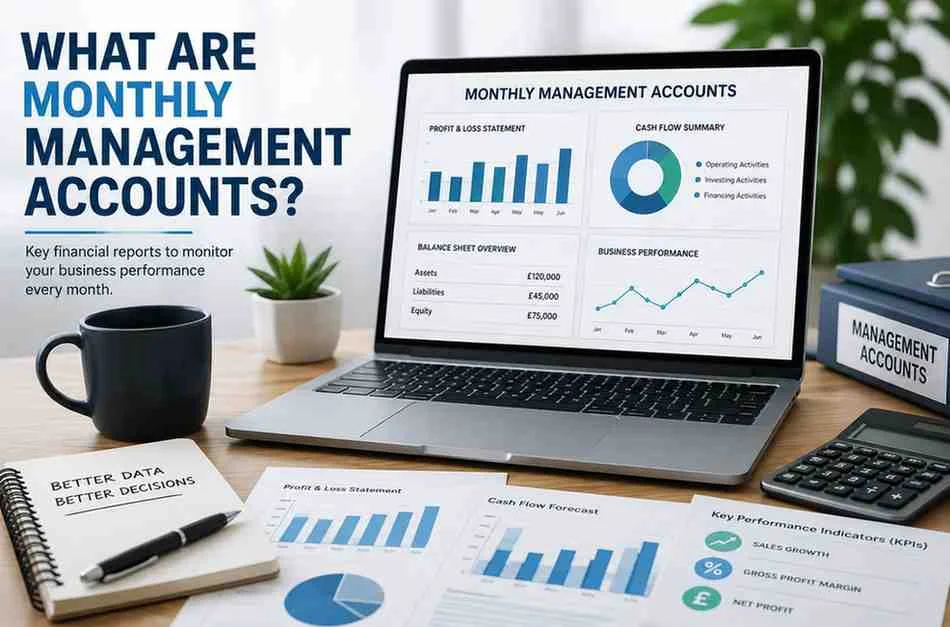
A proper set of monthly financial reports usually includes four core pieces. None of them are optional if you want the full picture.
1. Profit and Loss Statement
This shows your income, your costs, and what’s left over. Simple in theory. In practice, it reveals patterns that annual accounts hide completely, like a slow leak in a tyre that only shows up if you check it often enough.
2. Balance Sheet
A snapshot of what your business owns and owes, on a specific date. Assets, liabilities, and equity, all in one place. It answers a blunt question: if the business stopped today, where would it stand?
3. Cash Flow Forecast
Profit and cash are not the same thing, and this is where many businesses get caught out. A company can be profitable on paper and still run out of money. The cash flow forecast tracks money moving in and out, and projects what’s coming next.
4. Key Performance Indicators (KPIs)
These are the metrics specific to your business, gross margin, debtor days, staff costs as a percentage of revenue, whatever actually matters for you. Generic accounts don’t include these. Good management accounts do.
Put these four together, and you get real management reporting, not just numbers for the sake of numbers.
Management Accounts vs Statutory Accounts: Not the Same Thing
This trips people up constantly, so let’s be direct about it.
Statutory accounts are backward-looking, legally mandated, and produced once a year. They’re built for external parties: HMRC, Companies House, sometimes investors.
Management accounts are forward-looking (or at least, present-focused), voluntary, and produced monthly or quarterly. They’re built for you, the person actually running the business.
One is a photograph taken once a year. The other is closer to a video, updated frequently enough that you can actually see the trend, not just the outcome. Waiting twelve months to find out your business had a rough Q2 is a bit like checking your smoke alarm once a year, after the fire.
Why Monthly Financial Reports Actually Matter
Here’s the logic in its simplest form: decisions made with current data tend to beat decisions made with stale data. That’s not controversial, yet plenty of businesses still run on gut feeling and last year’s numbers.
Monthly management accounts give you a few concrete advantages:
- Early warning signs: A dip in margin or a spike in costs shows up in month two, not month eleven.
- Better cash management: You can see a cash squeeze coming before it becomes a crisis.
- Stronger conversations with lenders and investors: Banks and investors trust businesses that clearly understand their own numbers.
- Sharper decisions on hiring, pricing, and spending: You’re reacting to reality, not to a memory of reality from ten months ago.
Business performance reporting, done monthly, essentially compresses your reaction time. And in business, reaction time is often the difference between a fixable problem and an expensive one.
How FA Accountants Approach Management Reporting
Not every accountant treats management reporting the same way, and that matters more than people realise.
Some firms hand over a template, fill in a few numbers, and call it done. Others treat management accounts as a genuine conversation, walking clients through what the numbers mean, not just what they say.
The second approach is the standard. A monthly management account should tell a story your finance team, or you personally, can act on. Not just a PDF that gets glanced at and filed away.
That means:
- Clear commentary alongside the numbers, not just raw figures
- KPIs chosen for your specific business, not a generic checklist
- Cash flow forecasting that actually accounts for your seasonality and payment terms
- A conversation, ideally, not just an email attachment
If your current management accounts feel like a chore to read, that’s usually a sign of how they were built, not a fact of life you have to accept.
How Often Should You Actually Review Them?
Monthly is the standard for most trading businesses, and there’s a practical reason for that specific interval. It’s frequent enough to catch problems early, but not so frequent that you’re drowning in reports and reacting to noise instead of trends.
Quarterly can work for very small or very stable businesses: Weekly cash flow snapshots make sense for businesses in high-growth or high-risk phases, alongside, not instead of, the monthly set.
The wrong frequency, in either direction, causes real problems: Too infrequent, and you’re always reacting late. Too frequent, and you start chasing every small fluctuation like it’s a crisis, which is exhausting and, frankly, not that useful.
Common Mistakes Businesses Make With Management Accounts
A few patterns show up again and again:
Treating them as a formality
Producing management accounts and never actually reading them defeats the purpose entirely. It’s like buying a gym membership and never showing up.
Ignoring trends across months
One month’s numbers rarely tell the full story. The value is in comparing month three against month one against month six.
Skipping the cash flow forecast
Profit gets all the attention, but cash problems are what actually close businesses down. A profitable company with poor cash timing can still miss payroll.
Using generic KPIs
A retail business and a services business shouldn’t be tracking identical metrics. Relevance matters more than volume.
Avoiding these four mistakes alone puts a business ahead of a large share of its competitors, most of whom are still figuring out where their bank statement went.
Getting Started With Monthly Management Accounts
If your business currently produces only annual accounts, you’re essentially driving while checking the mirror once a year. It works, technically, right up until it doesn’t.
Monthly management accounts don’t need to be complicated: A clear profit and loss statement, a current balance sheet, a realistic cash flow forecast, and a handful of KPIs that genuinely reflect your business, that’s the core of it.
The businesses that grow steadily tend to share one habit: they know their numbers before a crisis forces them to look. Monthly management reporting is how that habit gets built.
Contact us Now If you’re unsure where to start, or your current reports raise more questions than they answer, that’s exactly the kind of conversation FA Accountants is set up to have.